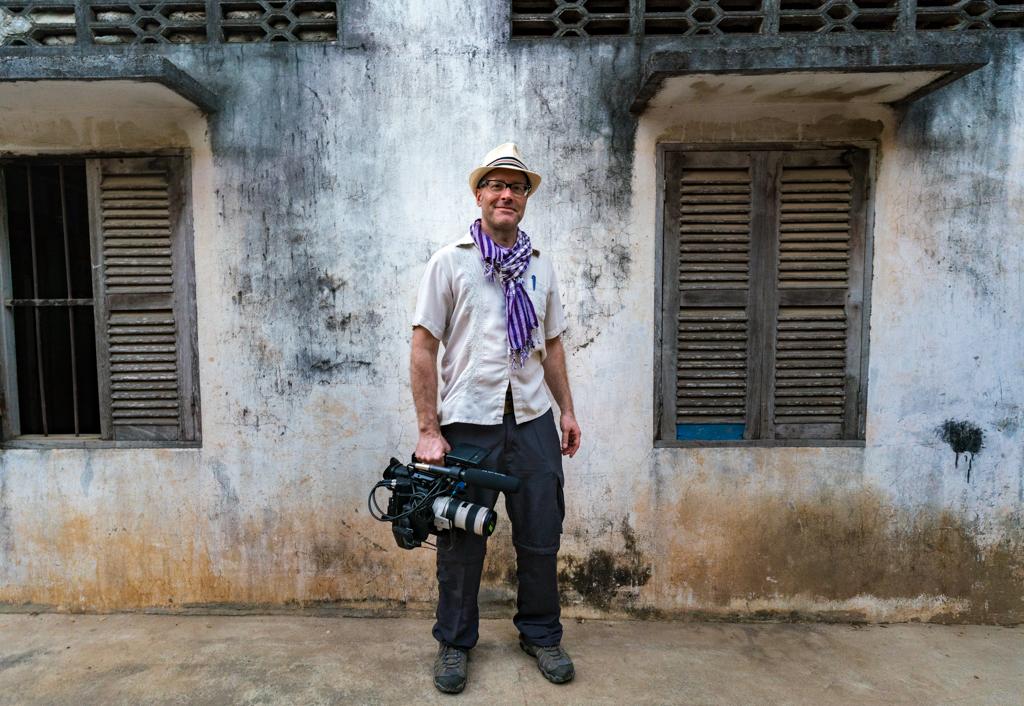
Based on a Desktop Documentaries webinar with filmmaker Chris G. Parkhurst, recorded September 23, 2026.
On his second day filming Journey to Kathmandu, Chris Parkhurst's camera stopped recording. He had spent a year and a half preparing for the project. Finding a replacement took another two days, eventually through a local filmmaker who rented him a similar camera package.
It's an experience that changed how Chris travels with equipment. It also touches on something that came up throughout our conversation about filming documentaries abroad: how much a production depends on the people you work with locally, from finding equipment to understanding what's happening in an interview.
Chris’s documentary work in Cambodia and Nepal has shown him how much local collaborators can shape a film. One longtime fixer had a gift for putting people at ease, whether they were government officials or farmers. A different experience revealed how easily that influence could become a problem: a replacement translator began helping interviewees formulate their answers, changing the material the filmmakers were capturing.
For Chris, building those working relationships often starts before he leaves home.
Research before filming abroad
Before traveling somewhere unfamiliar, Chris starts immersing himself in material from and about the place: books, films, blogs and its history. He also looks for filmmakers who have worked there and can talk about the experience of making a film on the ground.
For projects in Cambodia and Nepal, that research included reaching out to Cambodian-American and Nepalese-American communities at home in the US. Those conversations offered perspectives on the culture and introductions to people with family and friends in the areas where he hoped to film.
They also began a relationship with a potential audience. People were learning about the project while Chris was learning about the place, well before he arrived with a camera.
He is clear about the limits of preparation from a distance. Spending time in-country changes his understanding of what working there will involve. On his own documentaries, he has allowed time to get to know the place and make connections before filming begins. The research continues through those encounters, as the people he meets add detail to what he thought he understood.
Working with local fixers
A fixer helps a production find its way locally, which can involve arranging introductions, organizing logistics and navigating unfamiliar situations. On some of Chris's shoots, the same person has also translated interviews. Their judgment affects both how the production works and how people understand the film being made.
On Bombhunters, the documentary that first took Chris to Cambodia as a sound recordist, the team set aside two days to meet potential fixer-translators. They spoke with roughly six to eight people before choosing two.
The collaborators they chose weren't necessarily the strongest English speakers. Chris remembers being drawn to their sensitivity, their experience with communities and the way they related to people.
One became a close friend whom Chris hired on subsequent projects. His background in archaeology had brought him into contact with local communities and officials, but Chris particularly valued his ability to put people at ease. He could walk into very different situations and establish a connection.
“Hire somebody that you are going to be counting on to be your right-hand person,” Chris says.
That role looked different on Journey to Kathmandu. There, Chris worked with separate people for local logistics and translation. One brought experience with trekking, the Nepalese crew and the communities they would visit; another had the language skills he needed for interviews. The demands of the project shaped the team.
When translation shapes answers
Four months into the Cambodia shoot, neither of the team's regular fixer-translators was available for a trip to a rural area. The filmmakers hired someone locally, with fewer candidates to choose from.
The replacement was personable and wanted to help. Within about an hour of interviewing, though, Chris and the team began to sense that something was wrong. As the translator explained the film and what they were looking for, he was also helping people formulate their answers.
“For him, he felt like he was doing his job,” Chris recalls.
They recognized the problem during filming, but the transcripts later showed how often it had happened throughout the day. Even with some awareness of what was going on, they hadn't fully understood or controlled it.
The incident exposes a difficult dependency in an interview conducted through another language. The filmmaker relies on the translator to carry the conversation, while having limited ability to assess every exchange as it happens. Someone's understanding of the film, and of their own role in making it, can influence the material that eventually reaches the edit.
Planning for equipment failure
The Kathmandu camera failure brought a different kind of dependency into view.
Chris was filming a tea merchant and his family, whose lives would provide a way into the festival at the center of Journey to Kathmandu. He was working in a small, busy shop, following the owner behind the counter and out onto the street. While filming near a steaming pot of tea, the camera stopped recording.
It was a tape-based HDV camera. Playback still worked, but he couldn't get it to record again. He suspected moisture might be involved and tried drying it out, without success. The camera wouldn't return to use until he could have it repaired after the trip.
He spent the next 48 hours trying to find a solution, including contacting Sony representatives. Eventually, he found a local filmmaker with a comparable HD camera package that he could rent.
The experience changed his approach to backups. Smaller cameras have since made carrying a second body easier, and Chris now travels with a duplicate. He also recommends making contact with local filmmakers who know the equipment options in the places where a production will be working.
His commercial work has influenced his preparation too. Working for clients requires budgets and shooting schedules to be settled before departure, and he has brought more of that discipline into his documentaries. At the same time, he knows that weather, access and circumstances can change a shoot. A schedule gives him something to work from as those changes happen.
Sharing the finished film
Chris's relationships with the people he films continue into the question of who gets to see the finished work.
After spending time in a community, he wants to return with the film and share what came from that experience. He sees that as part of his responsibility to the people whose stories made it possible, as well as something he looks forward to himself.
With Elvis of Cambodia, taking the film to rural communities has been an important ambition. He describes it as a celebration of Cambodia and a love letter from him and his wife to the country and its people. Sharing it there belongs within his idea of the filmmaking process.
Across these projects, the relationships have lasted much longer than individual shoots. Collaborators have become friends, and the people Chris has filmed remain part of his life after the camera is packed away. When he talks about working abroad, those connections are central to both how the films get made and what making them means to him.
More from Chris
Explore Chris's filmmaking work at Barang Films and his conversations with fellow filmmakers on The Documentary Life.
Related reading: Living a Documentary Life: Five Questions with Chris G. Parkhurst.
For more on preparing and conducting interviews, see our documentary interviewing tips.